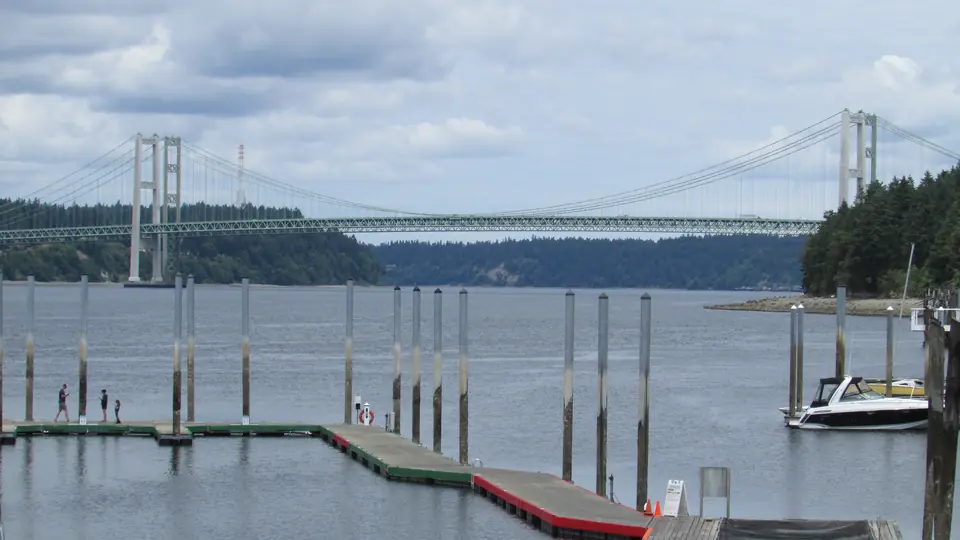
What should I do if my car breaks down on the Tacoma Narrows Bridge?
If the car still rolls, keep going and stop once you're off the span. If it stopped on the bridge in a travel lane, put the hazards on, keep your belt on, and call 911 first. Then call for help with the car. Don't walk on the deck.
The Narrows has two spans on SR 16, one carrying each direction. Both are long suspension bridges over open water, and wind and spray make the deck a bad place to stand.
Once you're safe, give the direction you were heading, toward Tacoma or toward Gig Harbor, and roughly where on the span you stopped. That's enough for anyone sent out to find you.
Does the Narrows Bridge toll matter if I break down?
Not for the breakdown itself. The toll applies only to trips headed to Tacoma, and the toll booths are reached from SR 16 exit 8. A Good To Go pass pays the lowest rate. If the car has to be towed across, ask the tow operator how the toll is handled.
Say which side of the bridge you are on, Tacoma or Gig Harbor, so the driver knows which way to come.
Toll rates and payment rules change. The WSDOT tolling page, listed under sources on this page, has the current ones.
Will traffic move over for my car on I-5?
Not necessarily. Washington's move-over law requires drivers to slow down or change lanes for stopped emergency vehicles, tow trucks and vehicles showing 360-degree warning lights. A car with only its hazards on is not named in the law, so traffic may pass close.
That is the main reason to stay inside the car with your belt on. People standing beside a stopped car on a freeway shoulder are at more risk than people sitting in it.
Once a tow truck or service vehicle is behind you with its warning lights on, drivers are required to slow down or move over. Even then, the person working at your car will tell you where to stand.
Where is the safest place to stop on I-5 through Tacoma?
An exit ramp, a wide right shoulder past the gore point, or any spot clear of the lanes where you can see far behind you. Avoid stopping on curves, on bridges, in the left lane median or at the end of an on-ramp where traffic merges.
If the car loses power, steer right and let it coast as far as it will go. Every few yards further from the lanes helps.
Through the Tacoma Dome district and Fife, I-5 carries heavy truck traffic. Turn the wheels away from the lanes so a push from behind sends the car off the road, not into it.
What should I do on the SR 509 and Port truck routes?
Pull well clear of the lane, because these roads carry heavy trucks heading to and from the terminals. Give the street name and the nearest terminal, bridge or rail crossing. If the car stopped on tracks, get everyone out and away, then call 911.
SR 509 runs through the tideflats past the Port of Tacoma and up Marine View Drive into Northeast Tacoma. Lift bridges and rail crossings can stop traffic suddenly, so keep a distance and watch the signals.
Trucks need room to swing wide. A car parked at a corner or a gate can be in their path even when it seems out of the way.
How long can I leave a broken-down car on the freeway?
Under RCW 46.55.085 an officer can tag a car left in a highway right-of-way and impound it if it isn't moved within 24 hours of the notice. If you can't move it, tell law enforcement. Arranging your own tow is cheaper than getting the car out of impound.
If you have to leave, take valuables and the registration with you, and lock the car.
See towing and roadside assistance for getting the car moved before the tag runs out.
How can I check traffic and closures before I drive?
WSDOT's real-time travel map shows incidents, closures and camera views for I-5, SR 16, SR 509 and the Narrows Bridge. Check it before you set out, and pull over safely before using a phone. The City of Tacoma's 311 line handles city street problems.
A closure or a crash upstream is a common reason drivers run low on fuel or overheat in stop-and-go traffic. Knowing early lets you take another route or fill up first.
For a flat tire, a dead battery, an empty tank or anything else, call the line or go to Tacoma roadside assistance.
What should I keep in the car for a breakdown in Tacoma?
A charged phone and a charger, a flashlight, a warm layer and a rain jacket, water, the wheel lock key if you have locking lug nuts, and reflective triangles. Check the spare tire's air a couple of times a year so it's ready when you need it.
Tacoma's wet months make a rain layer and a flashlight the two things people most often wish they had. A small blanket helps if you have to wait in a car with no heat.
Keep the registration and insurance card where you can reach them without opening the trunk. You may need them for a lockout or a tow.
Should I use reflective triangles on the I-5 shoulder?
Only if you can place them without walking into traffic or along a narrow shoulder. On I-5 and SR 16, staying in the car with your belt on is usually safer than walking back to set triangles. In a wide pull-off or on a city street, they help drivers see you.
If you do set them, walk on the side away from traffic, face oncoming cars, and keep it quick.
Hazard lights, interior lights at night, and a raised hood also help other drivers spot a disabled car.